KULA FIRE RESTORATION
Restoring Kula’s fire-affected landscape as one connected watershed.
The August 2023 Kula Fire crossed property lines, watersheds and neighborhoods. Recovery has to do the same.
KCWA coordinates long-term ecological restoration across the fire-affected landscape — bringing neighboring landowners, restoration practitioners, cultural and scientific advisors, agencies and community members together to stabilize damaged land, protect recovering areas, rebuild native vegetation and steward the watershed over time.
KCWA coordinates long-term ecological restoration across the fire-affected landscape — bringing neighboring landowners, restoration practitioners, cultural and scientific advisors, agencies and community members together to stabilize damaged land, protect recovering areas, rebuild native vegetation and steward the watershed over time.
WHY THIS WORK IS NEEDED
The fire changed the landscape overnight. Recovery will take years.
The August 2023 Kula Fire burned through a landscape that was already under pressure from invasive vegetation, browsing by feral ungulates, altered land use and decades of ecological change.
The fire intensified those pressures.
Across steep portions of the burn area, protective vegetation was lost and soils were left exposed. Black wattle and other invasive plants began rapidly reclaiming disturbed ground. Axis deer continued browsing recovering vegetation and moving across property boundaries. Heavy rain now interacts with a landscape whose ability to hold soil, slow water and support vegetation was significantly disrupted.
And because this landscape is divided among dozens of privately owned properties, those challenges cannot be solved one parcel at a time.
Water moves downhill. Deer cross fences and roads. Invasive seeds spread. Fire moves through connected fuels. What happens on one property can affect neighbors — and the watershed below.
That is why KCWA works at the landscape scale, coordinating restoration across approximately 120 acres of the Kula Fire area.
Our goal is not simply to repair what burned. It is to help the landscape recover ecological function: keeping soil in place, slowing and holding water, reducing invasive dominance and hazardous fuels, protecting regeneration from ungulates, rebuilding diverse native vegetation, and strengthening the community stewardship needed to sustain that recovery over time.
THE LANDSCAPE WE’RE RESTORING
One watershed. Dozens of properties. A shared recovery.
The Kula Fire burn area is not one property or one project site. It is a connected landscape of homes, gulches, former pasture, invasive forest, recovering native vegetation and privately owned lands within the Waiakoa Watershed.
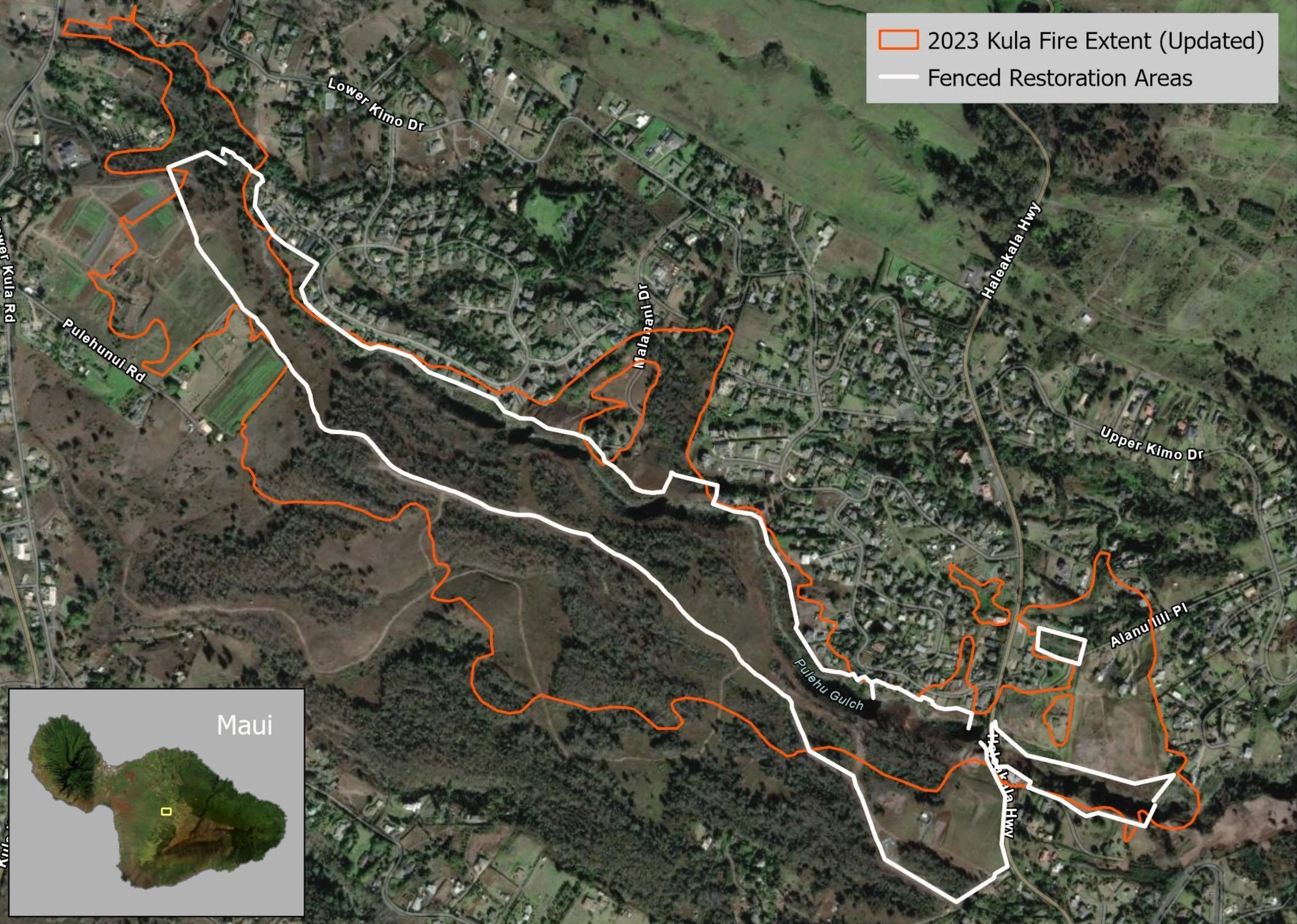
KCWA is coordinating restoration across approximately 120 acres and 84 properties, with much of the work centered along the Pōhakuokalā–Pūlehu gulch system.
That scale matters.
Water flows downhill across property boundaries. Deer move through the landscape. Invasive plants spread from one parcel to another. Wildfire moves through connected vegetation and fuels. Ecological recovery therefore depends on neighbors working together.
KCWA helps turn many individual properties into one coordinated restoration effort — connecting fencing, invasive-species management, erosion control, native planting, monitoring and long-term stewardship across the landscape.
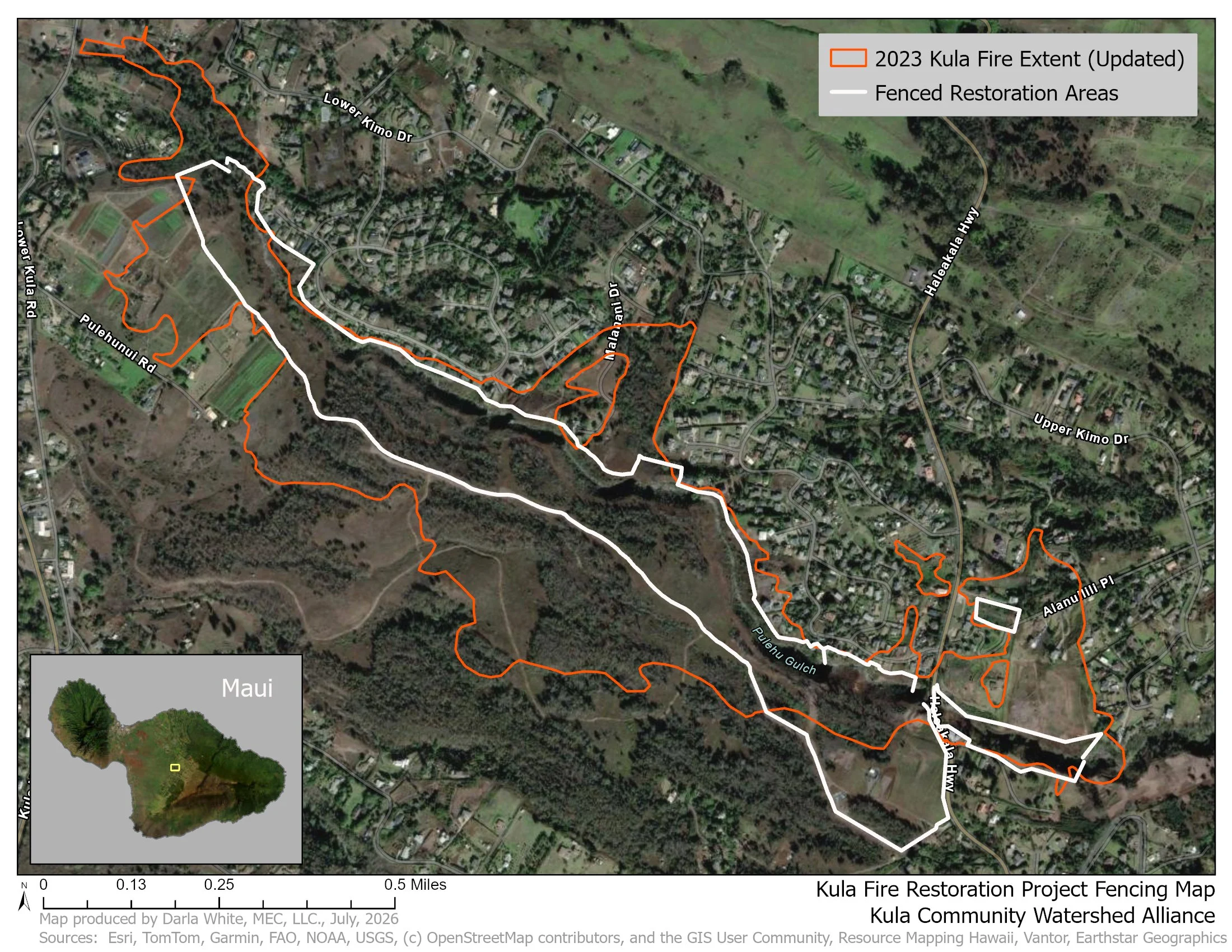
Participating properties remain privately owned and individually stewarded. KCWA helps coordinate restoration so that work on one property contributes to recovery across the larger watershed, and to remove the additional burden from Kulaʻs fire survivors.
How we restore the landscape
KCWA’s restoration work follows a simple sequence, but the phases overlap and repeat as conditions change.
A burned landscape cannot move directly from disturbance to recovery. Soils need to be stabilized. Regenerating areas need protection. Native vegetation needs help re-establishing. And every treatment requires follow-up.
This is how we organize that work:
STABILIZE
Reduce immediate post-fire damage and create safer conditions for recovery.
We manage hazardous vegetation and woody debris, protect exposed soil, slow erosion, reuse biomass as mulch, and prepare damaged areas for restoration.
PROTECT
Reduce the pressures
that prevent recovery.
We install and maintain
conservation fencing, manage ungulate
pressure, suppress invasive vegetation, maintain access, and protect newly stabilized areas from being repeatedly disturbed.
RESTORE
Rebuild living structure and
ecological function.
We establish native trees, shrubs, ferns and groundcovers, improve planting conditions, support soil health, and reconnect recovering vegetation across the landscape.
MAINTAIN
Stay with the land long enough for restoration to take hold.
We return to inspect, weed, repair,
monitor, replant and adapt treatments as conditions change.
Restoration is not linear.
A site may move through these phases more than once. A storm can create new erosion. A fence can be breached. Invasive plants can reappear. Young plants can need another season of care.
That is why long-term stewardship is not a final step added after restoration.
It is part of restoration itself.
HOW THE PIECES WORK TOGETHER
Restoration works as a system.
No single treatment restores a watershed.
Fencing without weed control leaves invasive vegetation in place. Removing invasive plants without protecting the site can leave disturbed ground vulnerable. Planting without follow-up care can lead to poor establishment. Erosion control without vegetation does not rebuild a living landscape.
KCWA combines multiple kinds of work so that each treatment supports the next.
Invasive species & fuels management
Reduces competition, hazardous biomass and repeated reinvasion.
Native propagation & revegetation
Rebuilds plant diversity, root structure, shade and long-term ecological function.
Fencing & ungulate management
Protects soils, young plants and natural regeneration from browsing and disturbance.
Monitoring, kilo & adaptive management
Helps us understand how sites are responding and where our approach needs to change.
Erosion control & soil protection
Helps keep soil, organic matter and moisture on the landscape.
Community stewardship
Provides the relationships, continuity and local knowledge needed to sustain recovery across many properties over time.
Each piece matters.
The real strength comes from how they work together.
COMMUNITY-LED ACROSS PROPERTY LINES
Ecological recovery requires social continuity.
The Kula Fire affected a landscape made up largely of privately owned properties. Restoring that landscape therefore depends on more than technical treatments. It depends on relationships, trust, shared information and long-term coordination among the people who live there.
KCWA was formed by fire-affected neighbors and continues to work directly with landowners across the burn area — walking properties, identifying needs, coordinating treatments, sharing field information and helping connect individual decisions to the larger restoration strategy.
That community structure matters because restoration takes years.
Fences need to be maintained. Invasive plants return. Young vegetation needs care. Storms change conditions. New problems emerge. The people closest to the land are often the first to notice those changes.
By building a connected network of participating landowners, field staff, technical advisors, cultural practitioners, agency partners and volunteers, KCWA is helping create the human system needed to sustain ecological recovery over time.
Healthy land depends on a community capable of caring for it.
SEE HOW THE LANDSCAPE IS CHANGING
From restoration work to ecological renewal
Explore the measurable progress, monitoring and signs of recovery we are tracking across the Kula Fire restoration landscape.
